
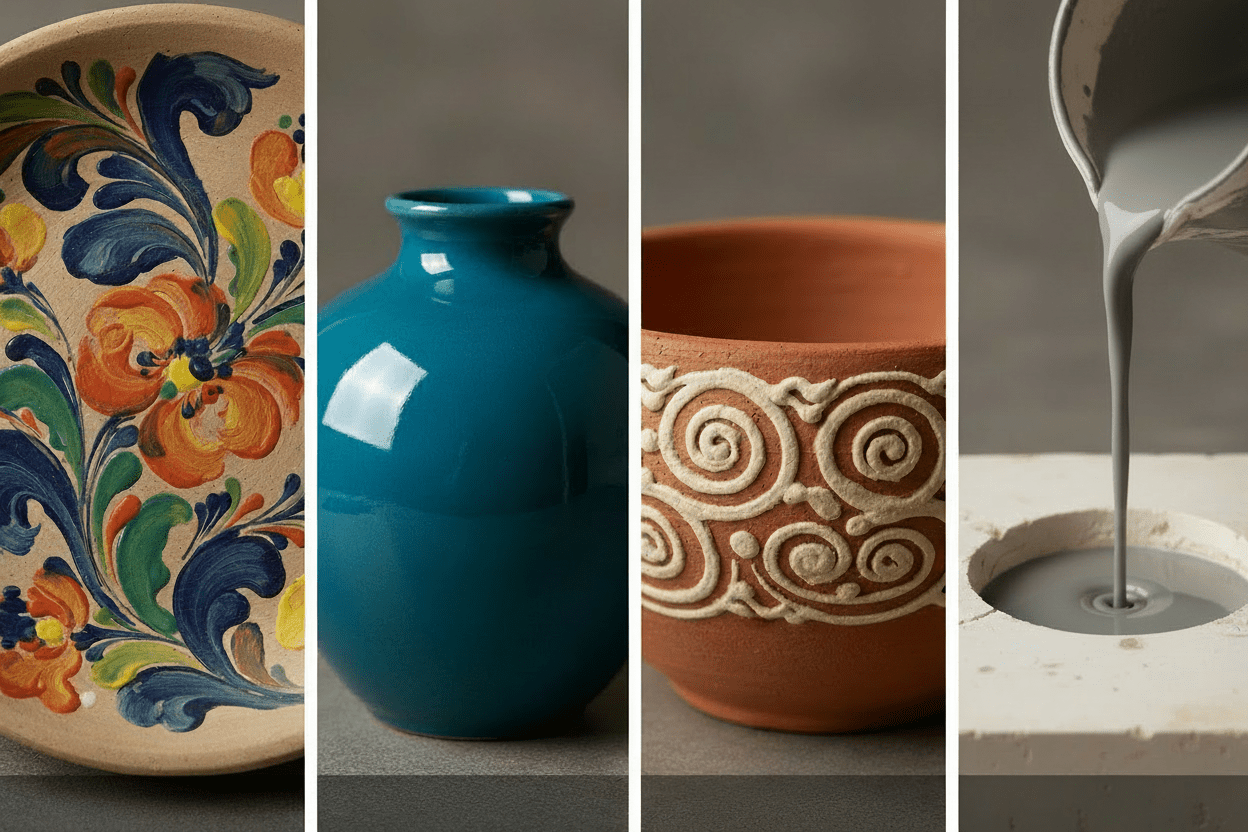
Open any ceramics supply catalogue and you'll find four categories that all sound like they might do the same job: slip, engobe, underglaze, and glaze. All four arrive as something wet. All four go on with a brush, a dip, or a pour. And all four end up as a permanent part of the finished surface once the piece comes out of the kiln.
But mix them up — apply a slip where the job actually called for an engobe, or skip the glaze that a food-safe mug needs — and the difference shows up fast, usually as flaking, crawling, or a piece that quietly isn't safe to eat or drink from. Understanding what separates these four materials isn't just terminology for its own sake. It changes how your work looks, how durable it is, and in some cases whether it's actually safe to use.
This guide breaks down exactly what each one is, when to reach for it, and — just as importantly — how potters combine them in an actual firing sequence, since none of these four exist in isolation.
The Quick Answer
If you only have thirty seconds, here's how the four compare:
| Slip | Engobe | Underglaze | Glaze | |
|---|---|---|---|---|
| What it is | Clay thinned with water | A refined slip with added flux and silica | A pigmented decorating medium, closer to a glaze in structure | A glass-forming coating |
| Roughly how much clay is in it | 50–90% | 25–50% | Low — built more like a glaze | None — it isn't clay-based |
| When it goes on | Wet through leather-hard, only | Wet through bone-dry, and often bisque | Mostly bisque (also leather-hard) | Almost always bisque |
| Main job | Joining pieces, simple decoration, slip casting | Changing or masking the clay body's colour and texture | Precise, paintable colour and fine detail | Waterproofing, sealing, final finish |
| Does it need a glaze over the top? | Yes, for a sealed surface | Optional | Usually, for full colour and durability | No — it is the seal |
| Food-safe on its own? | No | Not reliably | No | Only if correctly formulated and fired |
Now let's take each one in turn.
What Is Slip?
Slip is the simplest of the four: clay that's been thinned with water until it pours or brushes like a thick cream. Most decorating slips are somewhere between 50–90% clay by weight, with the rest made up of water and, often, a small amount of flux or colourant.
Potters reach for slip for three distinct jobs:
- Joining. The classic "score and slip" method uses slip as a kind of glue, welding a handle, spout, or seam to the main body of a leather-hard piece.
- Decorating. Slip can be trailed on in raised lines with a slip trailer, dipped over a whole form, marbled into another slip for an agateware effect, or laid down in coloured layers as the base for sgraffito carving.
- Slip casting. A thinner, deflocculated version of slip — with a chemical added to keep it fluid without needing much water — gets poured into plaster moulds to cast hollow forms with sharp, repeatable detail. If you want to go deeper on this specific technique, it's covered in our guide to handbuilding, throwing, and slip casting.
The catch with slip is its working window. It only bonds reliably to wet or leather-hard clay. Try to apply it to bone-dry greenware or bisqueware and it won't shrink or adhere properly — it'll flake straight off. That's the gap engobe was developed to fill.
On its own, fired slip stays matte and porous. It isn't waterproof and it isn't food safe until something is done to seal it — which is where glaze usually comes in.
What Is Engobe?
Engobe is best understood as an engineered version of slip. It still starts with clay, but at a lower ratio — typically 25–50% — with more added flux and silica, and often a portion of calcined (pre-fired) clay to control shrinkage. That shift in recipe is what gives engobe its defining advantage: a much wider working window.
Where slip only bonds to wet or leather-hard clay, a properly formulated engobe can be applied at the leather-hard stage, on bone-dry greenware, and in many cases on bisqueware too — because the added flux helps it grip and behave predictably even when the body underneath has already lost most of its moisture.
Engobe's main job is changing or masking the colour of the clay body underneath — useful if you love throwing with a particular clay for its workability but want a different colour or a more opaque, even surface for decoration. It's used constantly in industrial ceramics for exactly this reason, and just as often by studio potters who want a soft, semi-matte decorative surface with or without a glaze on top.
Here's the honest part: in casual use, "slip" and "engobe" get used almost interchangeably, and that's not really wrong. Even among professional potters, the exact line between them varies by region — some draw a firm distinction based on the recipe and the drying stage it's used at, while others use "engobe" as a catch-all term for any clay-based surface coating, full stop. If you hear both words applied to what looks like the same jar of coloured slurry, you're not missing something — the boundary genuinely is blurry.
What Is Underglaze?
Underglaze is where things start to feel less like clay and more like paint. Commercially, it's a refined, pigmented decorating medium — coloured with metal oxides or ceramic stains, and built with a small amount of flux and suspension aids (things like bentonite, CMC gum, or veegum) to keep it smooth, brushable, and consistent from jar to jar.
It comes in several forms: liquid in jars or bottles, solid pans or cakes you wet like watercolour, pencils, and chalks or pastels for dry application. Most commercial underglaze is designed to go onto bisqueware, since that stage gives the most predictable, controllable result, though many brands also work on leather-hard or even greenware.
The name gives away its intended role: it's usually meant to sit under a clear or coloured glaze, which is what gives the colour its final depth, shine, and durability. Left unglazed, underglaze dries to a matte, slightly porous finish — sometimes exactly the look a potter wants on a decorative or non-liquid-holding surface, but not something to leave bare on the inside of a mug.
Using underglaze to accentuate texture. If you're pressing texture into a piece with a clay stamp or a texture roller, a thinned wash of underglaze (or a contrasting slip) brushed over the textured area and then wiped back with a damp sponge before it fully dries is a classic way to make that detail pop. The colour pools and stays in the recessed lines while wiping cleanly off the raised surface — the same wipe-back logic behind the traditional mishima inlay technique, just applied to a stamped texture instead of a hand-carved line.
The same trick works nicely on a pressed maker's mark: press your signature stamp into the base while the clay is still soft, then once it's leather-hard, rub a little contrasting slip or underglaze into the impression and wipe the surrounding surface clean. The mark reads crisply once fired, instead of disappearing into the same-coloured clay.
What Is Glaze?
Glaze is the true outlier of the four, because it isn't really "coloured clay" at all — it's a glass-forming coating, built from silica (the glass former), a flux such as feldspar or a prepared frit (which lowers silica's melting point to something a kiln can actually reach), and alumina (a stabiliser that keeps the melted glass from sliding straight off the pot).
In the kiln, that mixture melts and fuses into an actual layer of glass bonded to the clay body — a process called vitrification. That's what gives glaze jobs no other material on this list can do on its own:
- Waterproofing. A properly fired glaze seals a porous clay body, which matters enormously for anything that will hold liquid.
- Food safety. For functional ware, a correctly formulated and fired glaze is what makes a surface genuinely safe to eat and drink from (more on this below).
- Protecting decoration. A clear glaze locks in any slip, engobe, or underglaze work underneath.
- Finish and colour. Gloss, satin, matte, crystalline, crackle — the surface character of most finished pottery comes down to the glaze recipe and how it's fired.
Glazes are formulated to mature at specific temperatures, generally grouped into low-fire (roughly cone 06–04, typical of earthenware), mid-fire (around cone 5–6, common for stoneware), and high-fire (cone 9–10, typical of porcelain and some stonewares) ranges. Check our calculator here for more cone/temperature settings. Getting the cone and the glaze matched to your clay body is its own topic — we cover it properly in Pottery Firing Temperatures Explained, and how the bisque stage fits into the sequence is covered in What Is Bisque Firing?
Most studio work follows a bisque-then-glaze sequence — bisque fire first, then glaze and fire again — though some potters use single-fire glazing, applying glaze straight to greenware and firing once. It's a real technique with real advocates, but it demands a glaze specifically formulated for it, so it's worth treating as an advanced detour rather than a default.
Is glaze food safe?
Not automatically, and this is worth taking seriously if you sell or use functional ware. A glazed surface is food safe when two things are both true: the glaze has matured fully in the firing (a full, glassy, crack-free surface, not an underfired or pinholed one), and the recipe doesn't rely on colourants or fluxes that can leach into food or drink. Historically that meant lead, which was a genuine hazard in old and improperly fired glazes; today the metals worth watching are things like barium, cadmium, and heavy concentrations of certain colouring oxides, particularly in glazes exposed to acidic foods like tomato sauce, citrus, or coffee.
A reasonable rule of thumb from glaze chemists: any recipe using more than about 3% of a single metal oxide colourant is worth testing for leaching before it goes anywhere near food. If you're using a reputable commercial food-safe glaze fired to its stated cone, you're on solid ground. If you're formulating your own for functional pieces, lab testing (rather than a guess based on the ingredient list) is the only way to know for certain.
If you sell functional ware, it's worth marking food-safe pieces clearly on the base so buyers never have to guess which pieces are dinner-safe and which are decorative only — something as simple as a dedicated food-safe stamp on the underside solves this at a glance.
How They Work Together: A Typical Firing Sequence
None of these four materials really exists in isolation — most finished pottery is the result of layering two or three of them in a specific order. A few common sequences:
Traditional slip-decorated stoneware. Form the piece → decorate with slip at the leather-hard stage (trailing, dipping, or as the base layer for sgraffito) → bisque fire → glaze → glaze fire.
Bisque-painted, commercial-style ware. Form the piece → bisque fire → paint underglaze detail onto the bisqueware → apply a clear or coloured glaze over the top → glaze fire. This is the sequence behind most mug-painting studios and a huge share of hobbyist ceramics.
Engobe-forward functional ware. Form the piece → apply engobe at leather-hard or bone-dry to change or mask the clay body's natural colour → bisque fire → glaze the interior and any food-contact surfaces (leaving the engobed exterior bare for a soft, matte finish, if desired) → glaze fire.
These aren't rigid rules, and potters mix and match constantly — it's entirely normal for one pot to carry slip-trailed decoration, underglaze detail, and a final glaze coat all at once. The one constant across every combination is that flux and clay-body compatibility matter at every layer, which is why testing on scrap tiles before committing to a finished piece is never wasted time.
Quick Head-to-Head Comparisons
Underglaze vs. Glaze
Underglaze is a pigmented painting medium used for precise colour and detail; glaze is a glass-forming coating used to waterproof and finish the piece. Underglaze usually goes on first and sits under a glaze, which is where the name comes from — glaze is typically the last layer applied before the final firing.
Engobe vs. Slip
Both are clay-based coatings, but engobe contains less clay and more flux and silica than slip, which lets it bond reliably at drier stages — including bone-dry and often bisque — where plain slip would simply flake off. In casual studio use, the two terms are frequently used interchangeably, and the line between them is genuinely blurry.
Slip vs. Underglaze
Slip is a simple, traditional clay-and-water mixture used for joining, casting, and decorating on wet or leather-hard ware. Underglaze is a refined commercial product built specifically for consistent, vivid, paintable colour, almost always intended to go under a final glaze.
Engobe vs. Underglaze
Engobe is the more traditional, often DIY-mixed option, generally applied earlier in the process (leather-hard through bisque) and prized for masking or changing a clay body's colour and texture. Underglaze is the commercial, artist-refined evolution of the same idea, formulated for precise, reliable colour and fine detail rather than broad coverage.
How to Choose: A Quick Decision Guide
- Joining leather-hard pieces (handles, spouts, seams)? → Slip
- Casting a hollow form in a mould? → Deflocculated (casting) slip
- Changing or masking the colour of your clay body? → Engobe
- Painting precise, consistent colour or fine detail? → Underglaze
- Accentuating a stamped or rolled texture? → A thinned wash of underglaze or slip, wiped back
- Waterproofing, sealing, and finishing a functional piece? → Glaze
Common Mistakes to Avoid
- Ignoring shrinkage compatibility. If a slip or engobe shrinks at a different rate than the clay body underneath, it will crack, flake, or peel away — sometimes not until well after firing. Our guides to clay shrinkage and why pottery cracks both dig into why this happens.
- Applying underglaze too thickly. A heavy application is more likely to crawl or bubble once the glaze goes on top — thin, even coats build colour better than one thick one.
- Applying slip where you needed an engobe. If the piece is already bone-dry or bisqued, plain slip won't bond properly — that's exactly the gap engobe is built to fill.
- Assuming a glaze is food safe because it looks fine. Vitrification and leaching aren't visible to the eye. If in doubt on a functional piece, get it tested.
- Skipping the test tile. Every combination of clay body, coating, and glaze behaves a little differently. A quick test firing catches problems long before they show up on a finished piece.
Frequently Asked Questions
Can I use underglaze without a top glaze?
Yes, on surfaces that won't hold liquid or touch food — many potters leave the exterior of decorative pieces bare over underglaze for a soft, matte look. For anything that holds water or food, a clear glaze over the top is what actually makes the surface waterproof and safe to use.
Is engobe the same thing as slip?
Not technically, but they're close cousins and the terms are often used interchangeably in everyday studio conversation. The practical difference is recipe and working window: engobe has less clay and more flux, letting it bond at drier stages — including bisque — where a plain slip would flake off.
Do glaze and underglaze fire at the same temperature?
They need to be compatible with each other and with your clay body's maturing temperature, but "compatible" doesn't always mean identical — it means formulated to work together at the cone you're firing to. Always check that a given underglaze and glaze are rated for the same firing range before combining them.
Can I make my own underglaze at home?
Yes — a basic underglaze is essentially a refined slip or engobe base with added ceramic stains or oxides for colour. Getting consistent, reliable colour takes some testing, which is why most beginners start with commercial underglazes before experimenting with their own recipes.
Is all pottery glaze food safe?
No. Food safety depends on the glaze being correctly formulated (avoiding excessive leachable metal oxides) and fully matured in the firing, with a smooth, crack-free surface. Reputable commercial food-safe glazes, fired as directed, are reliable; anything homemade or of unknown origin for functional ware is worth lab testing rather than assuming.
Isn't slip just wet clay? What actually makes it different from the clay body?
Functionally, slip usually is the same clay (or a contrasting one) at a much higher water content — thinned until it pours or brushes rather than holds its shape. What makes it "slip" rather than just "wet clay" is the intended use: joining, casting, or decorating, rather than building a form.
Final Thoughts
Slip, engobe, underglaze, and glaze all sit on the same spectrum — from simple clay-and-water at one end to a fully glass-forming coating at the other — and understanding where each one sits on that spectrum makes every decision after it, from technique to firing schedule, a lot more predictable.
Whichever combination you settle on for a piece, the tools you use to prepare and texture the surface matter just as much as what you paint or dip it in afterward. If you're looking to add more texture and dimension to your work before you reach for a slip trailer or a glaze brush, our stamps, texture rollers, and texture balls are built for exactly that stage of the process.
Share:
How to Attach Pottery Handles: A Complete Guide to Strong, Beautiful Attachments
How to Make Pet Paw Print Keepsakes in Clay