
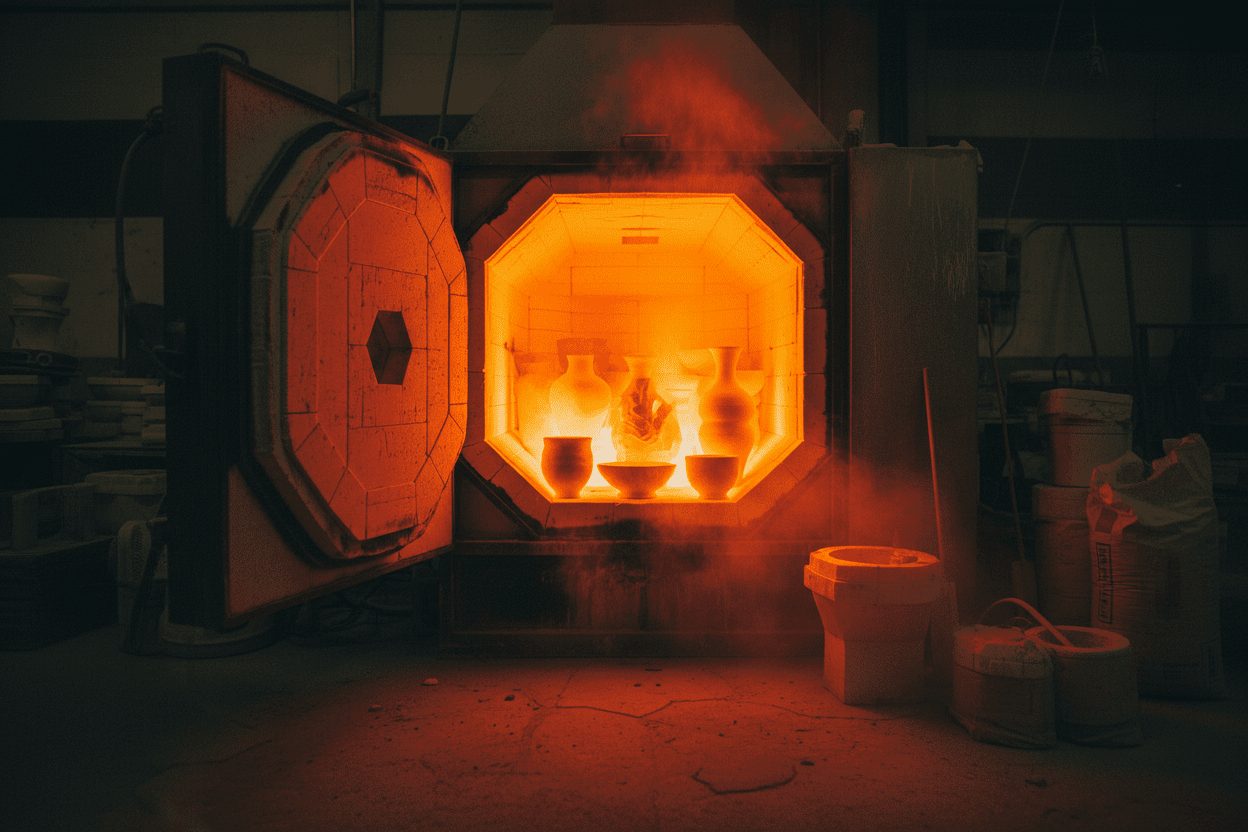
Pottery Firing Temperatures Explained: A Complete Guide to Cones, Heat, and Clay Maturation
Understanding firing temperatures is fundamental to successful pottery. The temperature at which you fire your clay and glazes determines everything from the strength and durability of your pieces to their color, texture, and functionality. Yet firing temperatures can seem confusing with terms like "cone 6," "low-fire," and "high-fire" being thrown around. This comprehensive guide demystifies pottery firing temperatures, explaining the cone system, temperature ranges, and how different firing temperatures affect your work.
Why Temperature Matters in Pottery
Clay is fundamentally transformed by heat. At room temperature, dried clay can be reconstituted with water and returned to a workable state. But once fired to sufficient temperature, clay undergoes irreversible chemical changes that create permanent ceramic material. The specific temperature you fire to determines how completely these transformations occur and what properties your finished pottery will have.
Fire too low, and your clay remains porous, weak, and potentially not food-safe. Fire too high, and your pieces may warp, bloat, or even melt. Each clay body has an optimal temperature range where it matures—where the clay particles bond sufficiently to create strong, durable ceramics while maintaining the piece's structure and form.
Glazes are equally temperature-dependent. A glaze formulated for cone 6 won't melt properly at cone 04, while a low-fire glaze fired to cone 10 will likely run off your piece or burn away entirely. Matching your clay body, glazes, and firing temperature is essential for successful results.
Understanding the Cone System
The pottery world uses a standardized cone system to measure heat work—the combined effect of time and temperature on clay and glazes. This system can initially confuse beginners, but it's actually more accurate than simply measuring temperature alone.
What Are Pyrometric Cones?
Pyrometric cones are small, slender pyramids made from ceramic materials formulated to bend and melt at specific temperatures. Unlike a thermometer that measures instantaneous temperature, cones measure heat work—how long the kiln has been at temperature, not just what temperature it reached.
This distinction matters because ceramics respond to heat work, not just peak temperature. A kiln held at 2232°F (1222°C) for three hours affects clay and glazes differently than a kiln that just touches 2232°F and immediately cools. Cones account for this by bending when they've absorbed sufficient heat over time.
The Cone Number System
Cones are numbered from 022 (lowest) through 14 (highest), with confusing numbering that includes both 0-numbers (like 06, 04, 01) and regular numbers (1, 5, 10). The zero-number cones represent lower temperatures, with higher zero numbers being cooler (cone 06 is hotter than cone 08, but cooler than cone 04).
Here's the key to understanding cone numbers: as you move from higher zero-numbers to lower zero-numbers, then into regular numbers, temperatures increase. So the sequence from coolest to hottest looks like: cone 022, 020, 018...08, 06, 04, 02, 01, 1, 2, 3...10, 11, 12.
This seemingly backward system exists for historical reasons, but once you understand the pattern, it becomes intuitive.
Self-Supporting, Large, and Small Cones
Cones come in three sizes. Large cones (about 2.5 inches tall) are placed in the kiln where you can observe them through a peephole during firing. Self-supporting cones have bases that keep them upright and are the most common for monitoring firings.
Small cones are used in kiln sitters—mechanical devices that shut off the kiln when a cone melts and triggers a release mechanism. Bar cones are used similarly in some automatic shutoff systems.
Different cone sizes bend at slightly different temperatures due to their thermal mass, so always use the cone size your firing schedule or kiln sitter is designed for.
Low-Fire: Cones 022 to 02 (1112-2048°F / 600-1120°C)
Low-fire temperatures are the coolest range used for finished pottery work. This category includes both very low temperatures used for specialty applications and the common earthenware range.
Cone 022 to 018 (1112-1319°F / 600-715°C)
These extremely low temperatures are used for overglaze decoration, lusters, and specialty finishes applied to already-fired ware. China painting and precious metal lusters fire in this range. You won't fire clay bodies to these temperatures as they remain essentially unchanged.
Cone 06 to 04 (1828-1945°F / 998-1063°C): The Earthenware Range
This is the most common low-fire range for functional pottery. Earthenware clays mature in this temperature range, creating relatively porous but adequate ceramic material. Most commercial pottery undergoes bisque firing at these temperatures.
Low-fire glazes offer the broadest color palette available in ceramics. Bright reds, oranges, yellows, and vibrant colors that burn out at higher temperatures remain stable in the low-fire range. This makes earthenware popular for decorative work, pottery with bright colors, and sculptural ceramics where color is important.
Advantages of low-fire:
- Vibrant color possibilities in glazes
- Lower energy costs (shorter, cooler firings)
- Less kiln wear and element degradation
- Easier kiln operation with less thermal stress
- More forgiving of minor firing mistakes
Limitations of low-fire:
- Pottery remains somewhat porous even when glazed
- Lower structural strength than higher-fired ceramics
- Not as durable for heavy use items
- Glazes can be less durable and more prone to scratching
- Less thermal shock resistance
Earthenware is perfect for decorative pottery, planters, tiles, and dinnerware that will be hand-washed. It's less suitable for ovenware or pieces subject to temperature changes.
Mid-Fire: Cones 4 to 7 (2167-2262°F / 1186-1239°C)
Mid-range firing has become increasingly popular, offering a balance between low-fire color possibilities and high-fire durability. This range, particularly cone 5-6, has emerged as a sweet spot for many contemporary potters.
The Rise of Mid-Range Firing
Traditionally, potters fired either low-fire earthenware or high-fire stoneware, with little middle ground. Modern glaze chemistry and clay body development have made mid-range firing increasingly viable. Today, cone 5-6 is one of the most common firing temperatures for studio potters.
At mid-range temperatures, stoneware clays begin to vitrify, creating non-porous, durable ceramics. The pieces are fully mature, strong, and completely functional for daily use including dishwashers and microwaves. Yet the firing costs less than high-fire and subjects kilns to less extreme conditions, extending their lifespan.
Mid-Range Glazes and Colors
Mid-range glazes offer an excellent compromise between low-fire color variety and high-fire depth. While you lose some of the brightest low-fire colors, you gain durability and the ability to achieve certain effects only possible at stoneware temperatures.
Many traditional high-fire glazes have been successfully reformulated for cone 5-6 firing. Celadons, tenmokus, shinos, and other classic effects work beautifully at mid-range. The slightly lower temperature actually benefits some glazes, providing more control over runny glazes and reducing warping issues.
Advantages of mid-fire:
- Fully vitrified, durable pottery
- Good color range in glazes
- More economical than high-fire
- Less kiln wear than high-fire
- Suitable for all functional ware
- More forgiving than high-fire for preventing warping
Considerations for mid-fire:
- Requires clay bodies formulated for mid-range
- Fewer commercially available glazes than low-fire or high-fire
- Still requires careful firing schedules
- Some traditional high-fire effects difficult to achieve
Mid-range firing works excellently for functional dinnerware, mugs, bowls, and any pottery intended for daily use. It's become the standard for many production potters and studio ceramicists.
High-Fire: Cones 8 to 14 (2280-2608°F / 1249-1431°C)
High-fire pottery represents the peak of ceramic durability and the traditional realm of fine stoneware and porcelain. These intense temperatures create the strongest, most refined ceramics possible.
Cone 9-10 (2300-2381°F / 1260-1305°C): Traditional Stoneware
Cone 10 is the classic high-fire temperature, used for generations by potters creating functional stoneware and porcelain. At these temperatures, clay bodies vitrify completely, becoming dense, strong, and often translucent in the case of porcelain.
High-fire creates pottery that's nearly indestructible under normal use. These pieces withstand extreme temperature changes, heavy use, and generations of service. Antique stoneware crocks and fine porcelain dinnerware fired at cone 10 can remain functional for centuries.
Glaze effects at high-fire are unique and prized. The extreme heat creates complex glaze interactions, allowing for deep, complex colors and surface qualities impossible at lower temperatures. Reduction firing (limiting oxygen in the kiln) at high temperatures creates distinctive color changes in both clay and glazes, particularly the copper reds and iron effects prized in Asian ceramics.
Porcelain: The Ultimate High-Fire Material
Porcelain reaches its full potential at high-fire temperatures. The clay becomes translucent, pure white, and incredibly refined. Porcelain fired at cone 10 achieves a glass-like quality with smooth surfaces and the ability to be thrown extremely thinly while maintaining strength.
Fine dining china, delicate sculptures, and artistic pottery often use high-fired porcelain to achieve their characteristic elegance and refinement.
Advantages of high-fire:
- Maximum strength and durability
- Complete vitrification and non-porosity
- Unique glaze effects and colors
- Traditional aesthetic valued in fine ceramics
- Resistance to thermal shock
- Extremely long-lasting finished pottery
Challenges of high-fire:
- Highest energy costs
- Maximum kiln wear and element replacement
- More prone to warping and firing problems
- Requires very careful firing schedules
- Limited color palette (some colors burn out)
- More technical skill required
- Longer firing times
High-fire is ideal for fine dinnerware, heirloom-quality pieces, porcelain work, and pottery where maximum durability justifies the additional firing costs and challenges.
Ultra-High Fire: Cones 11-14 (2419-2608°F / 1326-1431°C)
These extreme temperatures are rarely used except for specialized applications like industrial ceramics, special porcelains, or experimental work. The extreme heat causes significant kiln wear and requires specialized equipment and expertise.
Matching Clay Bodies to Firing Temperatures
Every clay body has an optimal firing range where it matures properly. Using clay outside its intended temperature range causes problems.
Underfiring Clay
Firing clay below its maturation temperature leaves it underdeveloped. The clay remains porous, weak, and potentially unstable. Underfired pottery may not be food-safe as bacteria can penetrate porous surfaces. The clay hasn't fully bonded, so pieces remain fragile and prone to breaking.
Overfiring Clay
Firing clay above its maximum temperature causes bloating, warping, or melting. The clay becomes overly vitrified, may develop blisters from gases that can't escape, or actually begins to melt and deform. In extreme cases, overfired pottery can stick to kiln shelves or completely collapse.
Reading Clay Body Specifications
Clay manufacturers provide firing range recommendations. A typical clay body might specify "cone 5-10," indicating it matures at cone 5 and can be fired up to cone 10 without problems. Fire within this range for best results.
Some clays have narrow firing ranges (cone 9-10), while others accept wider ranges (cone 5-10). Production potters often prefer wide-firing clays that forgive temperature variations and allow flexibility in firing schedules.
Temperature Measurement and Monitoring
Accurate temperature monitoring ensures successful firings. Modern potters use multiple methods to verify their kilns reach proper temperature.
Pyrometers and Thermocouples
Pyrometers are electronic thermometers that measure kiln temperature using thermocouples (heat-sensing probes). While convenient for monitoring firings in real-time, pyrometers can drift out of calibration over time. Never rely solely on pyrometer readings without confirming with witness cones.
Witness Cones
Witness cones placed in the kiln provide visual confirmation of heat work. Arrange three cones—one below target, one at target, and one above—to clearly see when the kiln reaches proper temperature. When the target cone bends to touch the shelf (about 3 o'clock position), the kiln has reached temperature.
For example, when firing to cone 6, use cones 5, 6, and 7. When cone 5 is fully down, cone 6 is bending, and cone 7 remains upright, you've reached cone 6.
Kiln Sitters
Older electric kilns use kiln sitters—mechanical devices that shut off the kiln when a small cone melts. While reliable, kiln sitters can fail, so many potters use witness cones as backup even with kiln sitters.
Computer Controllers
Modern electric kilns use computer controllers that run pre-programmed firing schedules. These controllers use pyrometer feedback to adjust heating rates and hold temperatures. Even with controllers, experienced potters place witness cones to verify the controller is functioning correctly and the kiln is firing evenly.
Firing Schedules and Temperature Ramps
How you reach target temperature matters as much as the final temperature itself. Firing schedules specify heating rates at different stages of firing.
Slow Initial Heating
Early firing stages require slow heating to allow water and gases to escape safely. Bisque firing typically heats slowly (100-200°F or 40-95°C per hour) through the first 1000°F (540°C).
Mid-Range Heating
Once past critical water and organic burnout phases, heating can proceed faster, typically 300-400°F (150-200°C) per hour through middle temperature ranges.
Final Climb and Soak
The final push to peak temperature may slow slightly, and many firings include a hold or soak at peak temperature. This soak (typically 10-30 minutes) allows the entire kiln to reach even temperature and ensures glazes fully mature.
Cooling Considerations
Cooling rates matter, particularly through quartz inversion at 1063°F (573°C). Cooling too quickly can cause dunting (thermal shock cracking). Most firings cool naturally without forced cooling until the kiln drops below 400°F (200°C).
Choosing the Right Firing Temperature for Your Work
Your choice of firing temperature should consider your creative goals, available equipment, and practical constraints.
For brightly colored decorative work, low-fire offers the best palette. For functional everyday ware, mid-range provides excellent durability at reasonable cost. For heirloom-quality pieces or fine porcelain, high-fire delivers maximum refinement and longevity.
Many successful potters work exclusively at one firing temperature, mastering the specific characteristics of that range. Others maintain multiple clay bodies and glaze palettes for different temperatures, choosing based on each project's requirements.
Conclusion: Temperature as a Creative Tool
Firing temperature is far more than a technical specification—it's a fundamental creative decision that shapes every aspect of your pottery. Understanding how temperature affects clay and glazes empowers you to make informed choices about materials and processes.
Whether you're firing low-fire earthenware at cone 06, mid-range stoneware at cone 6, or high-fire porcelain at cone 10, understanding the characteristics, advantages, and challenges of each temperature range helps you create successful pottery. The cone system, while initially confusing, provides a standardized language that allows potters worldwide to share techniques, recipes, and results with confidence.
As you gain experience, you'll develop intuition about temperatures—understanding by feel and sight when a kiln is approaching temperature, recognizing properly matured clay and glazes, and knowing which temperature range best serves your creative vision. This knowledge, built through practice and observation, becomes an essential part of your pottery mastery.
Share:
What is Bisque Firing? A Complete Guide to the First Firing
Hand Building Pottery Techniques: A Complete Guide for Creating Beautiful Ceramics Without a Wheel